Academic Program Registration
The Approval and Registration Process
Cornell maintains a dynamic portfolio of academic programs that advances our educational mission and serves our students' evolving needs. Our programs must comply with requirements from multiple governing bodies: the U.S. Department of Education (ED), the New York State Education Department (NYSED), the State University of New York (SUNY—for contract colleges), and our institutional accreditor, the Middle States Commission on Higher Education (MSCHE). These agencies require universities to establish rigorous processes for reviewing and approving new programs and modifications to existing ones.
Our comprehensive review process evaluates proposals in light of Cornell's academic and strategic priorities while also giving careful attention to external regulatory obligations.
Academic program development and the ensuing review and approval processes can be involved. Taking into account the external approval processes that must complete before a program can launch, it may take two years or more to move from initial approvals to student enrollment. The review steps and timeline are detailed below.
The Review Process
Cornell uses a phased review process to advance academic program proposals:
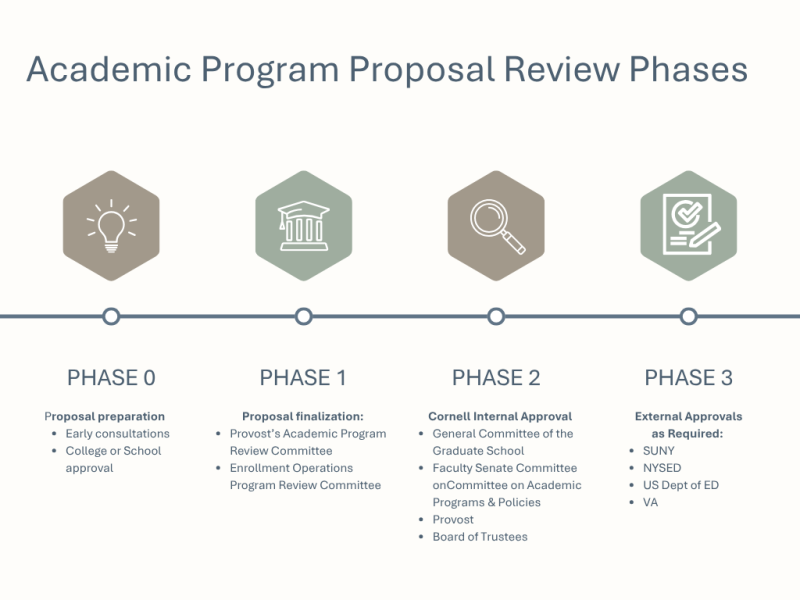
Program administrators, faculty, and staff work within their College to design new programs or revisions to existing programs.
Early in the proposal development process, meet with your department chair and College Dean's office to confirm strategic alignment, available resources, and your College's approval pathway. Proposals will eventually require a faculty vote and a letter from the Dean, so it is important to have these discussions early on to understand your college's approval pathway.
Once you have conceptual support within your unit, contact the Office of Institutional Research and Planning (IRP). IRP staff manage academic program registration with SUNY, NYSED, and MSCHE and serve as trusted advisors in navigating the proposal process. They can also provide you with a timeline estimate, dependent on the nature of the proposal.
Two groups provide an early review of proposals with the goal of refining program concepts and design to create a stronger overall plan. This process begins with an internal proposal form that collects some of the key information that subsequent reviewers will also be considering.
Process: Submit an online internal proposal form that collects information required for external applications.
Review committees:
- The Provost's Academic Program Review Committee examines:
- Evaluate institutional fit and need
- Assess market and student demand
- Consider program distinctiveness and enrollment feasibility
- Reviews financial plans and sustainability
- The Enrollment Operations Academic Program Review Committee:
- Identifies regulatory compliance issues and operational challenges
- Provides feedback to strengthen proposals and enable early decision-making on modifications.
- The Associate Deans Council
- Assesses alignment with existing college offerings
- Considers cross college contexts and implications
Phase 1 feedback informs Phase 2 internal approvals and serves as the decision point for advancement. Proposals must be approved in Phase 1 to proceed to Phase 2. During Phase 1, proposals may return to PAPRC for additional review if challenges arise.
Depending on the proposal type, one or more of these bodies will provide required internal approval:
- General Committee of the Graduate School
- Faculty Senate Committee on Academic Programs & Policies
- Provost's Staff Council
- Board of Trustees
External review may include:
- State University of New York (SUNY - Contract Colleges)
- New York State Education Department
- Middle States Commission on Higher Education
- U.S. Department of Education
- U.S. Department of Homeland Security
- U.S. and New York Veterans' Administration
Timeline Expectations
Anticipate a minimum of 2 years from Phase 1 submission to program launch, though development and approval times vary significantly based on proposal complexity.
Consult with IRP early to understand your specific proposal's timeline requirements.
Phase-by-Phase Breakdown:
- Phase 0: College/School Development – Timeline varies
- Phase 1: Internal Review – 1-3 months, depending on proposal complexity and revision cycles
- Phase 2: Internal Approvals – 3-6 months, subject to faculty and university committee meeting schedules
- Phase 3: External Approvals – 6 months to 2 years, depending on proposal complexity, number of revision cycles, and the number of regulatory bodies involved
Important Planning Note:
Programs cannot be offered to students or publicly advertised until all phases are complete.
Resources
Forms and Guides:
- Phase 1 Program Proposal Form
- Proposer's Guide (coming soon!)
Key Contacts:
- Institutional Research and Planning
- Provost's Academic Program Review Team
- Graduate School
- Office of Enrollment Compliance & Design
- Office of the University Registrar