Cornell University Academic Programs of Study Proposer's Guide
Purpose and Scope:
This guide aims to serve as a practical, step-by-step resource to help proposers plan, develop, and submit high-quality academic program proposals at Cornell University. It is designed to be helpful both before you propose (concept development, stakeholder consultation, materials preparation) and during proposal submission and routing (checklists, timelines, and approvals).
Cornell strives to maintain a complementary, robust portfolio of academic programs of study that advances our mission and serves students well. Proposals should demonstrate clear academic merit, distinctiveness within Cornell’s offerings, student demand, and sustainable resource plans—so that new or revised programs represent prudent, evidence-informed investments in student success.
Academic programs of study offered by Cornell are governed by requirements of the U.S. Department of Education, the New York State Education Department, the State University of New York (for Cornell’s contract colleges), and Cornell’s institutional accreditor, the Middle States Commission on Higher Education. These bodies expect universities to have strong institutional processes for vetting and approving academic programs. This guide translates those expectations into a clear, workable process for Cornell proposers.
When to use this guide:
Use this guide to propose a new credential (degree, major, or registered certificate, see below for definitions) and for substantive changes to existing programs (curriculum, title, delivery mode, credit hours, concentrations, admissions or completion policies), as well as suspensions or discontinuations. Do not use the guide or processes described herein for standalone course changes that do not materially affect program requirements.
Who should use it:
Faculty leads, program directors, department chairs, dean’s offices, and administrative partners involved in developing or revising academic programs.
Phases of the Approval Process
This section of the guide is designed to help proposers navigate Cornell’s internal approval workflow step by step. It explains who reviews your proposal, in what order, what each decision means, and how to move forward efficiently from concept to final internal approval.
Review teams involved in the multi-phase approval process depend on the type of proposal submitted. Each type of proposal is identified with one of the following engagement types for each review team:
- Reviews and Approves: Formal review and decision required before advancing.
- Receives FYI: Body is notified; no decision required unless they escalate concerns.
- No Review No FYI: Body is not engaged for this proposal type.
The criteria used to evaluate a program proposal will vary depending upon the program itself, and are determined by the role of each governing body reviewing the proposal. Nevertheless, certain criteria should apply to the review of all academic programs. By the time a program is recommended for approval by the Provost, it will have been evaluated according to the following standards:
- Academic quality;
- Justification of needs (to include societal needs in terms of state, regional, and national needs; career opportunities for graduates; and student interest);
- Relationship to other programs at CU (e.g. possible duplication);
- Resources available to implement the program
Before your proposal enters the approval pipeline, it must have passed your College or School’s approval process.
At the earliest stage of proposal ideation, meet with your department chair and the Dean’s office to confirm strategic fit and resources, and to identify your College or School’s pathway to approval. Each proposal must include a faculty vote and a letter of support from each College or School Dean affiliated with the program, prior to final approval.
Once you have support for the concept, we encourage you to contact the Office of Institutional Research and Planning (IRP). IRP staff will shepherd you through the approval process, will guide you in completing required forms, and will serve as a knowledgeable resource throughout the process.
We encourage you to consult early with:
- Your College Registrar on topics related to the University Catalog, SIS feasibility, degree audit, course and room scheduling, and credit-hour compliance
- Your College Budget and Finance team to discuss startup and ongoing costs and funding sources.
- The Office of Financial Aid and Student Employment to review student support and aid eligibility
- The Office of the University Bursar if your proposal includes a unique tuition structure.
When you have completed your internal College review and approval process, you’ll complete the Phase 1 Intake Form (guidance provided below).
Phase 1 is the initial phase of institutional review. The Phase 1 Review Team evaluates concept proposals for strategic fit, student demand, distinctiveness within Cornell’s portfolio, and feasibility across enrollment, space, and financial planning. Using the Academic Program Proposal Form and brief supporting materials (market analysis, enrollment projections, high-level curriculum, and resource overview), the team determines whether a proposal should proceed through the approval process.
Outcomes generally include an approval to advance (sometimes with conditions to address in Phase 2), a request to revise and resubmit, or a decision not to advance. A Phase 1 green light signals that the idea aligns with Cornell’s priorities and warrants a full internal governance review.
Timeline: Proposals are generally reviewed within three to four weeks following submission. Please note that the review process may involve multiple iterations, and the overall duration can vary depending on whether additional information or clarification is required.
What to submit:
| |
|
|
|
|
|
|
|
|
|
|
|
|
|
|
Once approved, you’ll be prompted to work with IRP staff to complete all required forms based on the type of proposal. Once those forms are complete, IRP will guide you through Phases 2 and 3, as applicable.
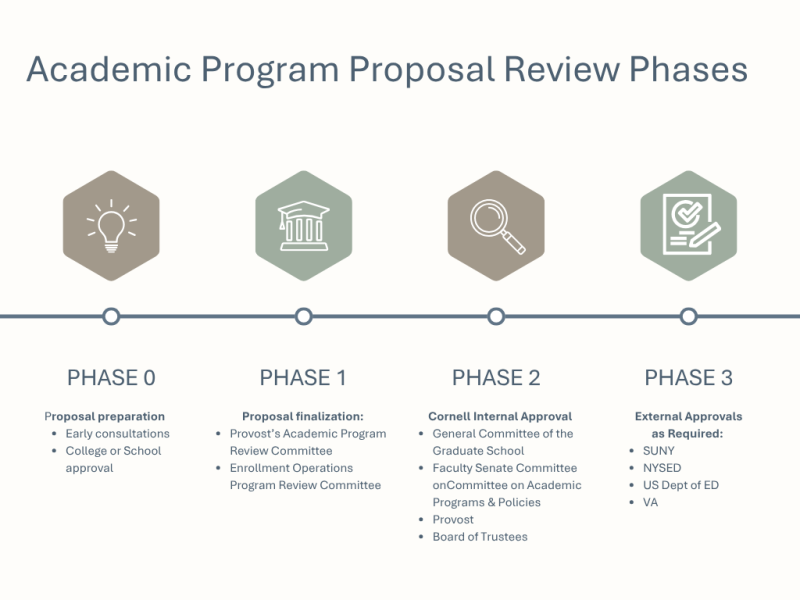
Phase 2 encompasses all Cornell internal reviews following the Phase 1 greenlight through Board of Trustees action. It begins with an Enrollment Academic Program Review focused on compliance for enrollment and student-facing operations (financial aid, student records/degree audit, bursar, global learning). From there, proposals follow the approval path based on program level: undergraduate proposals are next reviewed by the Office of the Vice Provost for Undergraduate Education; graduate/professional proposals route either directly to the General Committee of the Graduate School (for research programs) or stop for review by the Graduate Course-Based Program Review Team (for course-based master’s programs). Next, the Faculty Senate Committee on Academic Programs and Policies reviews proposals that involve more than one college or school. The Provost’s Council then provides the final internal check and approval, addressing any remaining issues identified throughout phase 2, after which proposals are presented to the Board of Trustees for approval or awareness, then either sent on to Phase 3, or released for implementation. Not every review body sees every change; the specific reviewers and actions vary by proposal type. See charts and workflows presented later in this guide.
- Step A: Academic Program Operations Team
Purpose: Ensures compliance with legal and regulatory requirements affecting enrollment and enrollment-adjacent operations (Financial Aid, Student Records, Bursar, Global Learning). - What to submit:
- Resolutions to any feedback provided by the Phase 1 Review Team;
- Completed SUNY and NYSED forms, as IRP identifies as required;
- Information on financial aid implications, degree audit rules, billing setup, SEVIS/immigration considerations, and nontraditional modes-of-delivery or calendars.
- How to submit: Once your program receives approval to move forward from the Phase 1 Review team, you will receive a communication from the Office of Enrollment Compliance & Design (OECD) providing you with a link to upload your completed materials for review, providing additional information specific to the operations functions under review.
- Schedule of Reviews: The Operations Team reviews proposals submitted by the 15th of the month by the end of that same month. Proposals are collated and provided to the team for review on the first business day following the 15th of the month. The team conducts their review and provides feedback through the last Friday of the month. OECD monitors feedback as it is returned and follows up with the proposers throughout the review process. A final summation of review team feedback and any responses provided by the proposers is provided within 1-2 business days following the close of the team’s review period.
Step B for Undergraduate Programs: Office of the Vice Provost for Undergraduate Education (OVPUE)
- Purpose: Comprised of Associate Deans and faculty across Colleges and Schools, the team reviews undergraduate program proposals, focusing on curricular design, course and content overlap, and faculty insights.
- What to submit: Resolutions to any feedback provided by any earlier review team, completed SUNY or NYSED forms, and detailed curriculum plans
- How to submit:
Step B for Graduate Course-Based Programs: Graduate Course-Based Committee
- Purpose: Comprised of Associate Deans and faculty across Colleges and Schools, the team reviews graduate course-based program proposals, focusing on curricular design, course and content overlap, and faculty insights.
- What to submit: Resolutions to any feedback provided by any earlier review team, completed SUNY or NYSED forms, and detailed curriculum plans
- How to submit:
Step B for Graduate Research Programs: General Committee of the Graduate School
- Purpose: Comprised of Associate Deans and faculty across Colleges and Schools, the team reviews graduate research program proposals, focusing on curricular design, course and content overlap, and faculty insights.
- What to submit: Resolutions to any feedback provided by any earlier review team, completed SUNY or NYSED forms, and detailed curriculum plans
- How to Submit:
Step C for multi-college proposals: Faculty Senate Committee on Academic Programs and Policies (CAPP)
- Purpose: Overseen by the Dean of Faculty, CAPP reviews academic program proposals to assess their quality, rationale, and alignment with institutional and societal priorities, ensuring they are well-conceived, relevant, and feasible when the proposal involves more than one College or School.
- What to submit:
- How to submit:
Step D: Provost’s Council
- Purpose: Chaired by the Provost and comprised of all Deputy and Vice Provosts, this team serves as the final stop before the proposal heads to the Board of Trustees. The review confirms all prior reviews were conducted and all questions and concerns were satisfactorily addressed.
- What to submit: Once your materials have moved through all prior approvals and all feedback has been addressed, IRP will prepare your proposal for review by the Provost’s Council.
- How to submit: IRP will coordinate the submission on your behalf.
Phase 2 finalization: Board of Trustees
- Purpose: The Board of Trustees, primarily under the operations of the Committee on Academic Affairs, is responsible for overseeing and ensuring the quality and strategic direction of the institution's academic programs. This notification or approval serves as the final step in the internal approval process.
- What to submit: IRP will include information about your proposal in the quarterly Administrative Report.
- How to submit: IRP will coordinate the submission on your behalf.
- Timeline:
Some proposal types require external approvals after Board of Trustees action before implementation can begin. These filings and approvals may include program registration through SUNY for contract colleges and through NYSED for all colleges; updates required by the U.S. Department of Education related to Title IV eligibility and institutional reporting; approvals by federal and state veterans benefits agencies to ensure students can use educational benefits; and, when relevant, distance education approval, SARA/state authorization, and SEVIS updates for international student compliance. Phase 3 steps are coordinated by the relevant Cornell offices and vary by change type. Proposals that do not trigger external approvals conclude at the Board of Trustees and move directly into implementation.
Completing the Phase 1 Proposal Form:
The Phase 1 program proposal form is the first step in initiating the academic program proposal process at Cornell University, and contains several fields, which are described below. Before starting on a new program proposal form, please read the following tips and guidelines to help you successfully navigate form features and requirements.
The program proposal form is dynamic - the fields that appear on the form will change depending on your answers to certain questions. For example, if you select you’ll be submitting a "New Academic Program, "a new field for “Additional Requests with New Program” will appear. This field will not appear when a revision request is selected.
Fields that are required include a red *. You cannot submit the proposal until all required fields have been completed.
Instructions for each question appear above the response field. Please read these instructions carefully before entering your information into the form.
Proposal Details
New Program or Revision to Existing Program
From the drop-down menu, select if the proposal is for a new program or arrangement, or a revision to an existing academic program.
Additional Requests with New Program
If the proposal is for the development of a new academic program, this field will appear. Select from the multi-select options if the proposal includes a request for graduate degree delegation, new transcriptable concentrations, or neither.
Summary
Provide 2–4 paragraphs describing the concept being proposed. Include a brief note of justification, distinctiveness vs. Cornell offerings, concentrations, accreditation intent (if any), and anything else that makes your proposal compelling.
- Provide a brief description of the program as it will appear in the institution’s catalog.
- How does the program relate to the institution’s mission and/or master plan?
Degree Type
Select all degrees associated with completion of the program included in the proposal from the multi-select options.
Program Name/Title:
This is the official title registered with NYSED and is what students will see when they interact with Cornell regarding the program. If this is a new program, enter the proposal name/title. If this is an existing program, enter the current name/title of the existing program. If this is a multi-program or award, please enter all program names/titles separated by a semicolon.
Transcriptable Concentration Name/Title
Transcriptable concentrations are officially registered with NYSED and appear on the student’s transcript. If your proposal includes adding a new concentration, enter the proposed name/title. If this is an existing concentration and you seek revision or elimination, enter the current name/title of the existing concentration. Separate multiple transcriptable concentrations with a semicolon.
Credit Hours Required for Transcriptable Concentration:
Please provide the total number of credits required for completion of the transcriptable concentration(s).
Total Credit Hours in Program:
Please provide the total number of credit hours required for program completion. If the program requires PE credits, include those credits in the total. For example, a 120 credit undergraduate program which also requires the completion of two 1-hour PE courses, becomes a program that requires 122 credits for completion.
Program Length
Provide the length in years for which the program is designed to be completed. For example, most undergraduate degrees can be completed in 4 years. Master's degrees are typically completed in 1-2 years. PhD programs are typically completed in 5-7 years. As you calculate the number of years of your program, Include all terms in which a student is required to enroll to complete the program.
Fall + Spring = 1 year
Fall + Spring + Summer = 1.5 years
Fall + Spring + Fall = 1.5 years
Fall + Spring + Fall + Spring = 2 years
Fall + Spring + Summer + Fall = 2 years
Fall + Spring + Summer + Fall + Spring = 2.5 years
And so on...
CIP Code
The Classification of Instructional Programs (CIP) provides a taxonomic scheme that supports the accurate tracking and reporting of fields of study and program completion activity.
If this is an existing program, enter the program's CIP code if known. If unknown, leave blank.
If this is a new program proposal, or you plan to revise the existing CIP Code, please visit the National Center for Education Statistics to search for key terms associated with your program to review and propose an appropriate CIP code. Please confer with your College Registrar for assistance in this review.
The US Department of Homeland Security maintains a complete list of fields by CIP code that fall within the regulatory definition of “STEM field." This list is known as the STEM Designated Degree Program list.
Program Delivery
Identify how the program will be delivered to students.
In Person: All courses can only be completed in-person. There are no online course elements.
HyFlex: All courses are available both in-person and online. The program can be completed fully in either mode of delivery.
Hybrid: Courses are available in a combination of online and in-person delivery modes; less than 50% of the program can be completed only via online delivery.
Distance Learning: At least 50% of the program can only be completed via online instruction with the occasional in-person course offering.
Note: A course is considered an online course if all instruction is delivered via one or more technologies to students who are separated from the instructor, either synchronously or asynchronously. A course is considered to be delivered online even if the course includes in-person, non-instructional activities such as orientation, testing, or academic support services. A course is not considered online if there is a combination of online and in-person instructional activities.
Program Location(s)
Please select from the list all locations where instruction for the program will occur. If you don't find a location, please add your location manually.
Courses Delivered via Distance Learning Only
Provide the total percentage of courses required for program completion delivered only via Distance Learning.
Program Management
Identify all entities involved in program delivery or administration.
Colleges or Schools involved in the Program *
Select all Cornell University Colleges or Schools involved in academic program delivery or administration.
If the program involves an external entity, select Non-Cornell Institution or Affiliate.
Non-Cornell Institution or Affiliate
You selected this program will be jointly offered with a Non-Cornell Institution or Affiliate.
List the Institution(s) or Affiliate(s) here.
College or School Seeking Delegation
Identify the college or school seeking delegation of program administration.
- Proposal option(s): Select all that apply; explain interdependencies in the Summary.
- Program Title: Student-facing title aligned with credential level and intended CIP; avoid confusion with similar programs.
- Transcriptable Concentrations: Exact names; attach requirements, outcomes, and sample plans for each.
- Total Credits and Program Length: Ensure compliance and feasible sequencing; include plan(s)-of-study.
- CIP Code: Provide a brief rationale and alternatives considered; coordinate with Institutional Research and the registrar early.
- Program Delivery and Location(s): State modality and sites; include distance education or authorization implications if applicable.
- Colleges/Schools involved: Identify the home department and all partners; attach dean letters and service-course agreements.
- Rationale for Proposal: Evidence-based need, distinctiveness, stakeholder engagement, and naming rationale if applicable; reference market/demand analysis and competitor scan.
- documented information on student demand should be included along with letters of support from graduate or professional programs for which the proposed curriculum will prepare students. In the case of associate’s programs, discussions with senior colleges on articulation agreement should take place before the proposal is officially submitted and should be mentioned in the document.
- Additional supporting documentation, such as student surveys and letters from potential employers, will strengthen the proposal.
- All statements about student demand and interest need to be based on supporting evidence, with an indication of the source. Some proposals offer extensive discussion of an important social issue, but do not connect that issue to the proposed curriculum and possible career outcomes for students.
- Evidence of Student Demand – There must be multiple measures of evidence that there is interest in this program on the part of students should be included. If the college conducted a survey to determine the need for the program, the actual survey form should be appended, as well as a summary of the findings
- Cornell Program Impacts: Enrollment shifts, course capacity, advising, faculty/TA needs, library/IT, facilities, overlap/duplication, and mitigation strategies; attach letters from impacted units.
- If a similar program exists elsewhere at CU, reach out to the colleges/schools/departments offering the program to discuss potential duplication issues and growth perspectives for the existing and prospective programs. The proposal should explain why student demand is not met through the existing CU program(s).
- External Competitors: Concise comparator list with distinctions; tie back to unique value.
- Careers Prepared For: Link outcomes and curriculum to career pathways; note licensure eligibility if applicable.
- Proposals should discuss employment opportunities and should include specific job titles with salary ranges, with data drawn from sources such as the US Department of Labor or appropriate professional organizations, and with sample entry-level job postings. The job postings must be directly relevant to the curriculum and should not require specific additional skills or expertise not developed by the proposed curriculum.
- Regional and National Employment statistics – Data on national and regional employment opportunities associated with this degree should be included
- Primary Contact: Faculty/program lead who can respond quickly during reviews.
Recommended Attachments
- Governance support to date, and attachments.
- Letters of support (deans, departments providing service courses, partners)
- Concept/program narrative
- Program learning outcomes and assessment plan
- Curriculum plan, curriculum map, and sample plans-of-study (each concentration if applicable)
- Resource and budget plan (faculty, TA support, labs/equipment, library/IT, financial aid, advising staff, registrar staff)
- Market/demand analysis and competitor scan
- Accreditation plan and timeline (if relevant)
- Teach-out/transition plan (for revisions/discontinuations)
- Distance education plan (if changing mode of delivery)
- New location site plan (if applicable)
- MOU Agreement(s) – Required only if the program involves multi-college or arrangements with an external entity
Credential Definitions
This is the list of credentials, if issued by Cornell University, are included on Cornell University transcripts with corresponding academic records maintained in the official Cornell University Student Information System.
Registered Certificates:
Undergraduate Certificates (< 1 year): An award that requires completion of an organized program of study at the postsecondary level (below the baccalaureate degree) designed for completion in at least 9 but less than 30 semester credit hours.
Undergraduate Certificate (>=1, <2 years): An award that requires completion of an organized program of study at the postsecondary level (below the baccalaureate degree) in at least one but less than two full-time equivalent academic years or designed for completion in at least 30 but less than 60 semester credit hours.
Undergraduate Certificate (>=2 years, <=4 years): An award that requires completion of an organized program of study at the postsecondary level (below the baccalaureate degree) in at least two but less than four full-time equivalent academic years, or designed for completion in at least 60 but less than 120 semester credit hours.
Post-baccalaureate Certificate: An award that requires completion of an organized program of study beyond the bachelor's. It is designed for persons who have completed a baccalaureate degree but does not meet the requirements of a master's degree.
Post-master's Certificate: An award that requires completion of an organized program of study beyond the master's degree but does not meet the requirements of academic degrees at the doctor's level.
Bachelor’s Degrees:
Bachelor's Degree: An award (baccalaureate or equivalent degree, as determined by the Secretary, U.S. Department of Education) that normally requires at least 4 but not more than five years of full-time equivalent college-level work. This includes bachelor's degrees in which the normal 4 years of work are completed in 3 years and cooperative work programs requiring a 5th year. Requires a minimum of 120 credits.
Master’s Degrees:
Master's Degree: An award that requires the completion of a program of study of at least one but not more than two of years of full-time academic work* beyond the bachelor's degree, or equivalent in part-time study with an accumulation of not less than 30 semester hours. Research or a comparable occupational or professional experience shall be a component of each master’s degree program. The requirements for a master’s degree shall normally include at least one of the following: passing a comprehensive test, writing a thesis based on independent research or completing an appropriate special project. At Cornell University, masters degrees may be either research based or focused on practical application.
Doctoral Degrees:
Doctoral Degree – Research: A Ph.D. or other doctor's degree consisting of advanced work beyond the master's level and requires a minimum of three academic years of full-time graduate level study including the preparation and defense of a dissertation based on original research, or the planning and execution of an original project demonstrating substantial artistic or scholarly achievement.
Doctoral Degree - Professional Practice: A doctoral degree that is conferred upon completion of a program providing the knowledge and skills for the recognition, credential, or license required for professional practice. The degree is awarded after a period of study such that the total time to the degree, including both pre-professional and professional preparation, equals at least six full-time equivalent academic years.
Doctoral Degree – Other: A doctoral degree that does not meet the definition of a doctoral degree-research/scholarship or a doctoral degree-professional practice and requires a minimum of three academic years of full-time graduate level study including the preparation and defense of a dissertation based on original research, the planning and execution of an original project demonstrating substantial artistic or scholarly achievement, or the verified development of advanced professional skills.